
Current Art Gallery Exhibits
Galleries One and Two
The Clayworkers' Guild Annual Members Show
October 1 - October 30, 2026
Awards Reception: Monday, October 5
- Time: 6:00 - 8:00 p.m.
- In-Person: MCC Conference Center, A211
Free and open to the public.
Since 1979, The Clayworkers’ Guild has been an organization of artists who use clay as an expressive medium. Members strive to aid, encourage, advise, and work together to support each other’s endeavors.
In 2022, the Guild expanded its presence by opening Artisans on Main at 220 Main Street, Woodstock, IL. The storefront showcases members’ pottery and ceramics for sale and serves as a teaching space for handbuilding, wheel-throwing classes, and special events.
Through its various activities, the Clayworkers’ Guild serves the community by supporting exhibits and workshops, offering community events for both its membership and the public, and supporting local charities across all aspects of ceramics and related arts. This year’s judge is Sonya Baysinger. Baysinger has served as Executive Director of the Skokie Northshore Sculpture Park for the past 11 years. She is originally from central Illinois and has lived in the Chicago area, by way of New York City, since graduating from art school. She earned her Master of Arts from Washington State University and her Master of Fine Arts from Southern Illinois University at Carbondale. She is a working artist and Instructor of Art at McHenry County College and Columbia School of Art, Chicago. She teaches courses in Sculpture, Jewelry/Metals, and 3-D Design. Her sculptures, jewelry, drawings, and paintings have been exhibited nationally and internationally. To date, these remain her primary vehicles of expression. In addition to various grants that have funded her projects and professional development, she has received the Arts Midwest Award and the National Endowment for the Arts Fellowship Award.
For more information about the Guild, visit their Instagram and Facebook page.
Epping Gallery
Eric Breitenbach
Young Hands, Ancient Lands
September 28 - October 30, 2026
Free and open to the public.
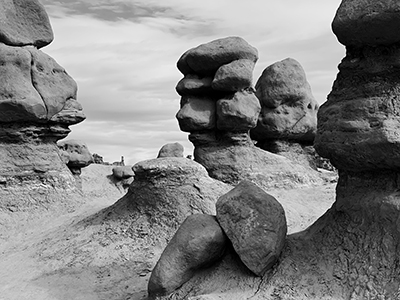
Image Credit: Eric Breitenbach, Goblin Valley State Park, 2025, Inkjet print
Young Hands
While living in Florida in the early 1980s, I read several books on the relationship between humans and non-human animals, but was struck in particular by Princeton philosopher Peter Singer’s Animal Liberation. It provided an entirely new perspective on what animals experience, need, and are owed by us humans. Being a photographer, I began to visit and document as many aspects of what Singer had discussed in his book. I went to farms, rodeos, equine events, municipal animal control departments, circuses, county fairs, and spent time with veterinarians and rehab/rescue group individuals. But it was the agricultural exposition at the Volusia County Fair in Deland, Florida, that drew my attention.
I began photographing the Fair in 2010 and went every November for five years, shooting 60 to 80 rolls of medium-format black-and-white film. I used Ilford Delta, which at ISO 3200 enabled me to photograph in the low-level lighting of the expo facility, which was filled with pens and stalls of farm animals: all tended to by youth ages five through nineteen. I think it was the innocence of the children combined with the awesome qualities of the animals, seen up close, that drew me in. Hovering over it all, of course, was the ultimate fate of such magnificent creatures, raised by the children, in many cases, from birth to their time at the Fair.
The Fair lasted ten days. I photographed most of those days. At first, the mood was light and carefree as the youth attended to their charges; grooming, feeding, medicating, and socializing with them. As the week went on, the mood turned a bit more serious as the judging of the youth and their animals drew near. That seriousness turned to an observable sadness on the final night. After the awards were presented, the enclosure darkened, and the animals were loaded into trucks and sent to processing plants – a contemporary, obscure euphemism for what were originally called abattoirs or slaughterhouses. Not every child wept that night, but quite a few did. I did, too.
Ancient Lands
In the 1990s, a friend took me skiing out West. I had learned to ski in the East, in small areas in New Jersey, Pennsylvania, and New York, but was never on a mountain that rose more than 2500 feet above sea level. The friend took me to Alta, outside of Salt Lake City, in the Wasatch Range, and both the mountain and the skiing were like nothing I had ever experienced. The summit at Alta was a little over 11,000 feet! It would be the last time I snow skied for the next thirty-five years. I picked it up again when I married at age sixty and inherited two thirty-something stepchildren, one a skier and one a snowboarder. I remembered Alta and went back to ski there, sometimes with family, sometimes alone, for three years in a row. The first year, the skiing was all I cared about, but as I began to travel more and more throughout the Salt Lake region – a lowland surrounded by a vast perimeter of enormous mountains – the area began to cast its spell on me. Other skiers and Salt Lake residents confirmed this; the mountains were, in fact, the reason they lived there. Those mountains, they get a hold of you.
Since 1989, he has produced documentaries for National Geographic Explorer, The Sundance Channel, The Sci-Fi Channel, and National Public Television. In 2014, with historian Leonard Lempel, he produced and directed Hoppin’ Rattlesnakes, Oral Histories of Beach Racing In Volusia County 1903-1958, a feature documentary on the history of beach road racing in Daytona Beach. In 2019, he directed Cultivating The Wild: William Bartram’s Travels, a documentary profiling six individuals following in the 18th-century naturalist’s footsteps. In 2026, also with historian Leonard Lempel, he produced, directed, and edited the feature-length documentary The Negro Is Here: The Life and Legacy of Mary McLeod Bethune.
He is a Professor Emeritus at Daytona State College and lives in Crystal Lake, Illinois, with his spouse – painter, embroiderer, and toymaker Kathy Maloney Johnson. For more about Eric, visit his website.
For more information, to request pricing, or to be added to the mailing list for upcoming exhibitions, email Trevor Power, Art Gallery Curator.